
Keweenaw County Release Meanings
A Keweenaw County custody exit is not one uniform event. The Sheriff operates a short-term lockup in Eagle River and contracts with neighboring counties for longer jail service. A person may be freed on bond, released after a court order, or moved to another county facility. Each event removes the person from the physical Keweenaw lockup. Only a dated release or transfer field explains what happened next.
The source depends on the custody level. The Keweenaw County Sheriff keeps the local booking and movement record. A court file supplies the legal basis for bond, dismissal, sentence, or another order. The Michigan Department of Corrections records prison, parole, probation, and discharge events for people under MDOC jurisdiction. MI-VINE relays reported custody changes, but it is an alert system rather than the agency record. Federal Bureau of Prisons and immigration systems cover separate custody chains.
Key distinction: leaving the Keweenaw lockup can mean release or transfer. Ask for the destination before treating the movement as freedom from custody.
Keweenaw County Release Types
The words on a Keweenaw County release record matter. Bond and personal recognizance end the present detention episode while the criminal case continues. Time served means the ordered custodial part of that case has ended, subject to other holds. Parole means an eligible person has left prison but remains under MDOC authority. Discharge generally marks the end of the stated sentence or supervision term.
A transfer is not a community release. The person moves into the physical control of another county, MDOC, a federal agency, or immigration authorities. A dismissal or acquittal may end authority in one case, yet another warrant or detainer can still prevent release. A detainer is a request or legal basis for another agency to take custody. These distinctions keep the record tied to the actual event.
| Record term | What it means | Next source |
|---|---|---|
| Bond or recognizance | Physical detention ends while the case remains open | Sheriff release field and court register |
| Time served | The custodial portion in that case is complete | Court sentence and Sheriff record |
| Parole | Prison release into MDOC supervision | OTIS Current Status and MDOC |
| Probation | A community sentence that may occur without prison | OTIS and the sentencing court |
| Discharge | The listed sentence or supervision term ended | OTIS, MDOC, or court order |
| Transfer | Custody moved to another agency | Receiving jail, MDOC, BOP, or ICE |
Keweenaw County Release Record Fields
A precise request should identify the fields that answer who left, when the movement occurred, why the Sheriff acted, and where the person went. Asking only for an “inmate search” may miss the release or transfer document. The local booking or custody record can connect a release event to the correct person and case, while the court file explains the legal authority.
A booking photo can be linked to the booking, but it does not prove release. The most useful items are the movement timestamp, disposition or release code, and destination. If the Sheriff transferred the person, the receiving agency becomes the source for the later custody endpoint. The following field inventory reflects the Keweenaw research and the Sheriff records-request path.
| Field | What it can show |
|---|---|
| Full name and identifiers | Connect the record to the correct person |
| Booking number | Tie later records to one custody episode |
| Admission date and time | Mark the start of Keweenaw physical custody |
| Arresting agency | Identify the agency that began the booking |
| Court or case number | Connect the movement to a public court file |
| Release or transfer time | Record when Keweenaw physical custody ended |
| Disposition or release code | Distinguish bond, order, completion, or transfer |
| Receiving agency | Identify the next custodian after a transfer |
Note: A common name is not enough for a sound match; compare the booking number, case number, middle name, and approximate date.
Request Keweenaw County Release Records
The Keweenaw Sheriff public-record request form is the documentary route when no online release entry exists. Describe an existing record instead of asking the agency to create a new report. Include the person’s full name, an approximate booking range, and a known case or booking number. Request the booking or custody sheet, release form, transfer document, and named movement fields. Ask for a booking image separately if it is needed and still releasable.
Michigan’s Freedom of Information Act requires a public body to take one of the allowed response actions within five business days. The body may grant, deny with reasons, grant in part, issue a permitted extension, or provide an authorized fee or deposit notice. That deadline concerns the response, not guaranteed production of every record. A written extension can add no more than ten business days under the statute.
- Identify the person, date range, and custody episode as narrowly as possible.
- Ask for booking, release, and transfer documents plus the release time, code, and receiving agency.
- Request electronic delivery and a cost estimate before charges exceed a stated ceiling.
- Read any cited exemption and accept lawful redaction when the rest of the record answers the custody question.
- Keep the request, confirmation, itemized fee notice, response, and produced record together.
Michigan law permits authorized actual costs and requires a detailed itemization. Paper copies are generally capped at ten cents per sheet, while labor follows the statutory method. Keweenaw has not published a flat fee for this exact release record. An inspect-first request or electronic copy may reduce cost. Never assume that the absence of a posted fee means the record is free.
Keweenaw County Record Retention
Online visibility and record retention are different. Keweenaw County has no identified public archive of released people. Michigan DTMB General Schedule 11, item 11.210, lists jail inmate jackets that may include booking cards, mug shots, court documents, bonds, prison-transfer papers, and inmate release forms. Its general minimum is release plus ten years, followed by destruction. An approved agency-specific schedule may supersede that baseline.
Property intake or release records and certain receipts have shorter general periods. A prompt, specific request is useful. Ask whether the Sheriff retains the item under General Schedule 11 or an agency schedule. Retention does not override a valid exemption, sealing rule, or court order. It also does not promise that every component was created for a short lockup episode.
- Set aside
- A Michigan process that can change public access to eligible conviction records after statutory conditions are met.
- Sealed record
- A record kept from ordinary public view under law or court authority.
- Discharge
- The end of the listed sentence or supervision jurisdiction, not merely departure from one building.
Michigan’s set-aside law begins at MCL 780.621. The applicable waiting clock can depend on sentence, probation, parole discharge, or completion of imprisonment. Once a record becomes nonpublic, an old image or saved profile should not be used to bypass the changed legal status. A set-aside date also does not establish the exact time a person walked out of a facility.
Keweenaw County Release Logistics
Keweenaw’s short-term arrangement changes pickup planning. The official Sheriff page does not publish a fixed release door, daily release hour, or weekend schedule. Call the Sheriff at 906-337-0528 and ask where the person is physically held before arranging a ride. The correct pickup point may be Eagle River, but it may be a contract jail that received the person.
The word “neighboring” is plural in the county description. Location should never be guessed from the nearest jail. Bed space, a court trip, a medical issue, or another agency hold can affect where the person is placed. Confirm the facility, expected movement, and any instructions directly. If staff cannot disclose the detail by phone, request the movement or transfer record.
Note: Keweenaw publishes no fixed release time, so a court event should not be treated as a pickup appointment without custody confirmation.
Find Keweenaw County Released Inmates
The strongest search follows the custody chain rather than one broad name query. Start with the Keweenaw Sheriff for a recent local arrest. Ask one direct question: was the person released to the community or transferred? Then use the answer to choose the next source. The full Keweenaw County released-inmate search is housed here because the county offers no separate released-person database.
- Call the Sheriff with a full name and approximate booking date. Ask for release versus transfer, the timestamp, and any receiving agency.
- If transferred, contact the named jail. Houghton County is a documented possible receiver only when a bed is available.
- Check MI-VINE for a reported custody event and confirm whether it says release or transfer.
- Use OTIS when prison, parole, probation, or recent MDOC discharge is plausible.
- Read MiCOURT for the order or disposition that may explain the movement.
- Use BOP or ICE only when the custody path became federal or immigration-related.
- Request the originating record when an online result is absent or unclear.
A no-result screen is inconclusive. The record may be local-only, too old for public OTIS display, misspelled, transferred, set aside, sealed, or held by another agency. For a recent local episode, Sheriff, VINE, and court records are the best combination. For a past state prison term, OTIS and the sentencing court usually provide the stronger chain.
Keweenaw County OTIS Release Search
The Michigan Department of Corrections Offender Tracking Information System covers prisoners, parolees, many probationers, and qualifying discharged people. It does not include every Keweenaw County arrest or short lockup stay. Search by MDOC number when known. Otherwise use a last name and first name, then narrow by age, sex, race, status, or identifying marks.
The official OTIS search interface shows the fields used for a statewide match.
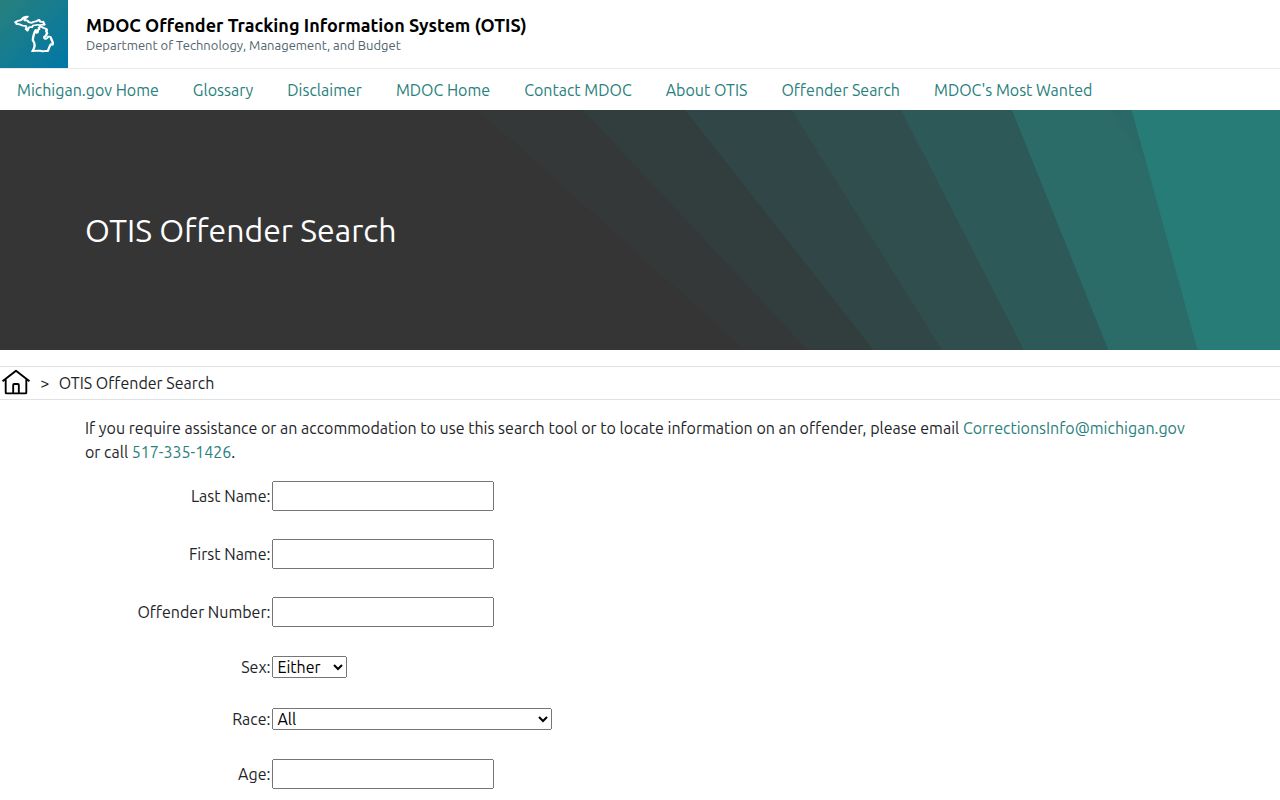
The image helps distinguish an MDOC number search from a local booking inquiry. Open a profile and compare the county, court file number, identifiers, and sentence rather than relying on the name alone.
| OTIS field | How it helps |
|---|---|
| MDOC number | Provides the most precise public search when known |
| Name | Starts a search but needs identity checks |
| Offender status | Narrows prisoners, parolees, probationers, discharged people, or absconders |
| Current Status | Shows the person’s present MDOC category |
| Earliest Release Date | Shows the earliest parole jurisdiction point, not a promised release |
| Maximum Discharge Date | Shows the calculated end of the maximum term if unchanged |
“Parole” confirms departure from prison into supervision. “Discharged” means MDOC jurisdiction ended, although OTIS notes that discharge can occur in more than one way. Qualifying public information is ordinarily removed three years after discharge. That web rule does not prove destruction of the underlying agency or court record.
Keweenaw County Recent-Release Gap
No verified Keweenaw Sheriff page publishes a current roster, booking search, release archive, rolling 24-hour list, or rolling 72-hour released-person list. No county Sheriff app or automated booking-photo social feed was documented. The 72-hour term on the county page describes the lockup’s holding function. It is not a feed window.
For a same-day or three-day check, call the Sheriff, review MI-VINE, read the court register, and request the exact release or transfer fields. There is no defensible online update cadence, field list, or retention window to report for a feed that was not found. The county’s 24-Hour Release List route uses that same-day fallback without claiming a non-existent roster.
Keweenaw County Court Release Proof
A Keweenaw court entry and a custody movement record answer different questions. The court register can show that bond was posted, personal recognizance was ordered, a charge was dismissed, a sentence was entered, or probation ended. The Sheriff record shows when physical custody changed and whether another agency received the person. Pair both records when possible.
The MiCOURT search portal can preserve public case events after a live custody entry disappears.
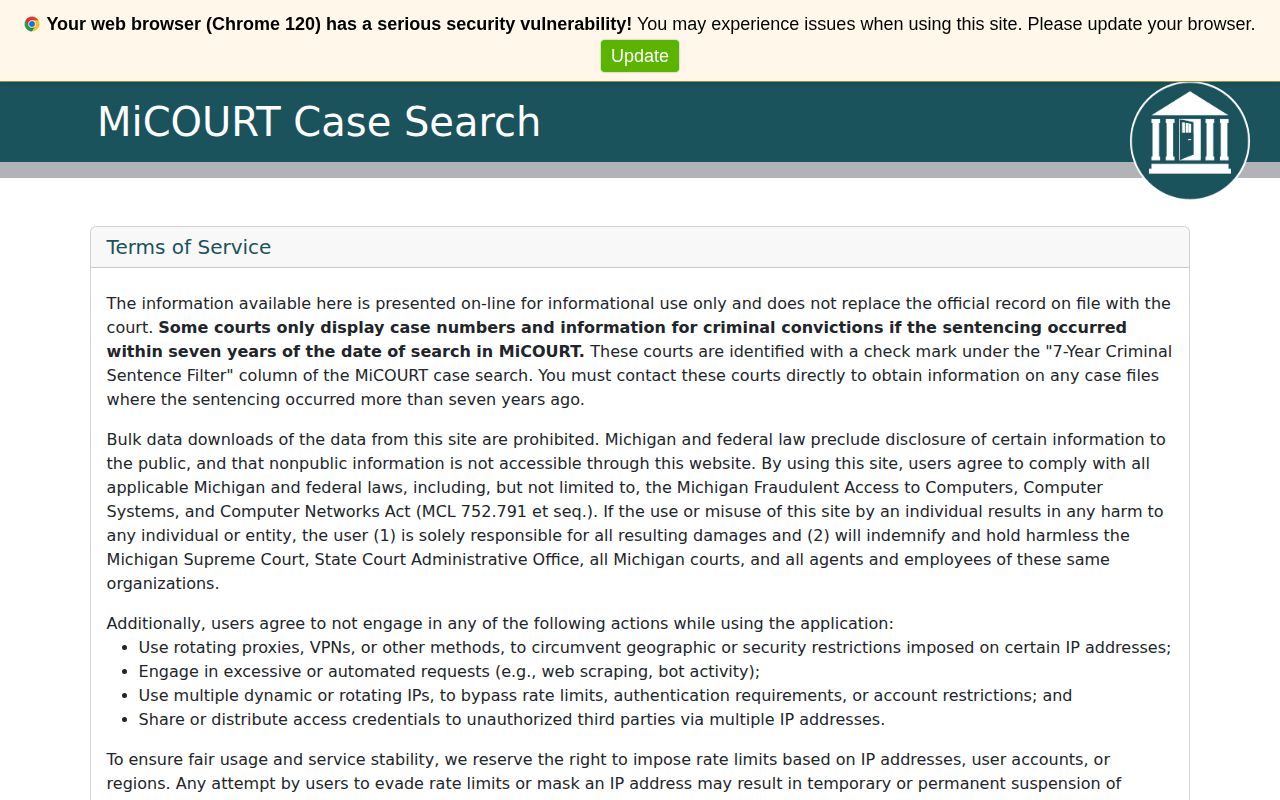
The portal is informational. Participating courts and display limits vary, and protected cases are excluded. Verify the correct court through the Michigan Trial Court Directory and use the case number whenever possible. The 97th District Court handles arraignment, bail, misdemeanors, and felony preliminary stages. The 12th Circuit Court is the durable source after a felony bindover and for felony disposition or sentence.
Bond authorization does not prove the jail-door time. Staff still process release and check other holds. A transfer record, in turn, proves movement without resolving the case. This local two-record method prevents a legal order from being mistaken for the final physical endpoint.
Keweenaw County VINE Release Alerts
MI-VINE is Michigan’s free, confidential custody-notification service. Search a specific person, confirm the reporting agency, and inspect the current event. A release event concerns departure from that agency. A transfer event means custody may continue elsewhere. Registration is available online, through the mobile app, or by telephone at 800-770-7657.
For a person under MDOC authority, read OTIS Current Status alongside VINE. Parole means prison release into supervision. Probation is a community sentence and may occur without prison. An absconder is a person whom the supervising authority says failed to remain available or comply; it is not a discharge. The sentencing court and MDOC field-office directory add documentary and current office context.
The Michigan State Police Sex Offender Registry is not a general release search. It applies only to people who have a legal duty to register and does not prove the date or manner of a Keweenaw County release.
Keweenaw County Federal Release Paths
Federal and immigration custody are separate from Keweenaw and MDOC systems. Use the BOP Inmate Locator for a federal sentence. It accepts a register number or a name with available identifying filters. A “Released” status and date establish departure from BOP custody, not freedom from every state, local, immigration, or supervision obligation.
The BOP Inmate Locator shows the separate federal search route for a person whose Keweenaw custody chain reached a federal sentence.
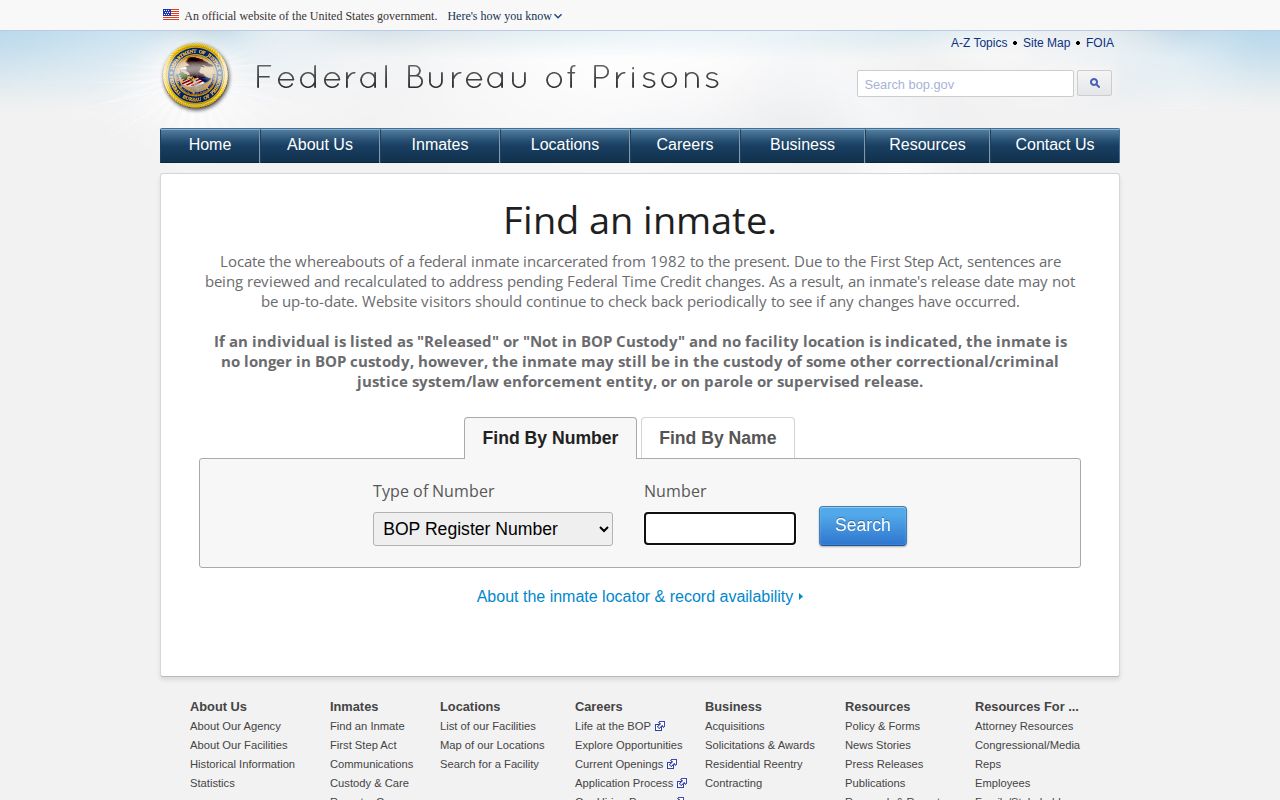
The federal result should be paired with the federal court case or a named receiving authority when transfer remains possible. The U.S. Marshals Service does not provide a nationwide historical recent-release roster.
ICE’s Online Detainee Locator is mainly for present immigration detention. Search by A-number and country of birth, or by name, birth details, and country. A no-result may reflect release, transfer, delay, short processing, or a mismatch. Ask the Keweenaw Sheriff whether the local movement was to ICE, then confirm with ICE or counsel. No BOP prison or dedicated ICE detention center was found in Keweenaw County.
Keweenaw Released or Still Held
One system cannot answer every custody question. A current jail view, if one existed, would show physical custody now. A release record documents an event after the person leaves that view. OTIS applies only when MDOC jurisdiction exists, while BOP applies to federal custody. The comparison below keeps those roles separate.
| Question | Best source | Main limit |
|---|---|---|
| Did Keweenaw release or transfer the person? | Sheriff phone and movement record | No public local roster or release feed |
| Does another county jail hold the person? | The named receiving agency and VINE | The receiver must be confirmed |
| Did a court authorize release? | MiCOURT and the court clerk | The docket may omit door time |
| Is the person on parole or discharged? | OTIS and MDOC | Local-only bookings may not appear |
| Did federal custody end? | BOP locator and federal docket | Another authority may still hold the person |
Which Agency Has the Person?
The most distinctive Keweenaw County release question is the next agency’s identity. The Sheriff’s phrase “neighboring Counties” does not name one fixed receiving jail. Houghton County Corrections is a documented possibility when space is available, but it must not be hard-coded as the destination for every person.
Ask Keweenaw for the receiving agency, movement time, disposition, and booking or reference number. Then contact that agency, check its VINE event, and request its later release or transfer record. If the receiver moved the person again, repeat the same chain. A custody path can include several physical transfers before community release, parole, or final discharge.
What if the Sheriff confirms transfer? Treat the Keweenaw event as the end of local physical custody, not the end of custody as a whole. The receiving agency controls the next answer.
Keweenaw County Release Facilities
The Keweenaw County Sheriff’s Office 72-Hour Lockup is the local short-term facility and first source for the release-versus-transfer decision. It can document the movement out of Eagle River. Its name does not create a rolling release list or guarantee community release by the end of that operating window.
The Houghton County Corrections Facility is a possible contract receiver. Its official corrections page says it houses Keweenaw Sheriff inmates when a bed is available. Confirm the actual destination before contacting Houghton, then ask whether that facility released the person, transferred the person again, or still holds the person.
Neither facility should be confused with an MDOC prison. A Keweenaw case that leads to state prison uses OTIS and MDOC records. Federal or immigration custody uses the corresponding federal system. The agency that created each movement record remains the best source for its part of the custody chain.
Public Record Search
Sponsored Results