
Keweenaw Projected and Actual Release
Michigan OTIS does not label one field “projected release date.” For a current MDOC prisoner, it displays Earliest Release Date and Maximum Discharge Date. The earliest date is generally the first point when the Parole Board has authority to release an eligible person after the minimum term. It is not a parole grant. The maximum date marks the calculated end of the maximum term if parole does not occur sooner, subject to lawful correction or recalculation.
An actual release date records the completed departure from an agency’s custody. It can differ from both OTIS dates. Board action, release planning, another hold, a court order, or a sentence change may intervene. For a person already released from prison, OTIS may show Date Paroled and an active parole status. A final discharge is different again because it ends MDOC jurisdiction rather than starting community supervision.
- Earliest Release Date
- The first possible parole-jurisdiction point shown by OTIS for an eligible prisoner.
- Maximum Discharge Date
- The calculated end of the maximum term, subject to lawful changes.
- Date Paroled
- The date MDOC records the person as released from prison to parole supervision.
- Detainer
- A hold or request from another authority that can affect where the person goes next.
Find Keweenaw Projected Release Dates
Classify the custody first. A person at the Keweenaw County Sheriff’s Office 72-Hour Lockup may be awaiting bond or another court step and may have no computed date. Because longer detention is contracted to neighboring counties, ask whether Keweenaw still holds the person or transferred them. Houghton County Corrections is a possible receiver when a bed is available, not an automatic destination. The actual custodian maintains the relevant jail computation.
For an MDOC prisoner, search the Offender Tracking Information System. An MDOC number is the best search key. Otherwise, use the name and available filters, then compare the county, court file, age information, and sentence. Open the current sentence block and read both date fields. Do not calculate a date from a headline sentence or from an unrelated profile with a similar name.
- Ask Keweenaw Sheriff whether the person is in the local lockup, was released, or was transferred.
- If transferred, obtain the receiving agency and ask that jail for its official computation.
- If MDOC custody is plausible, search OTIS by MDOC number or a carefully matched name.
- Read Earliest Release Date, Maximum Discharge Date, Current Status, sentence entries, and the Keweenaw case information together.
- Check the sentencing court for corrections, consecutive terms, jail credit, and later orders.
- Confirm a pending departure through MDOC or the holding jail rather than treating an estimate as final.
A federal sentence uses the BOP locator and federal law, not Michigan OTIS or county good-time law. A no-result in one system is not interchangeable with proof from another. The Keweenaw County released-inmate search separates local, state, federal, and immigration custody when the correct level is unclear.
Keweenaw OTIS Release Date Fields
The official OTIS About guide explains the search scope and field meanings. OTIS includes MDOC prisoners, parolees, many probationers, and qualifying discharged people. It does not cover every Keweenaw arrest or short local stay. The profile may also show Current Status, assigned location or supervision information, sentence and offense data, county, parole or probation terms, and an image date.
The field-definition screen below comes from that OTIS About guide.
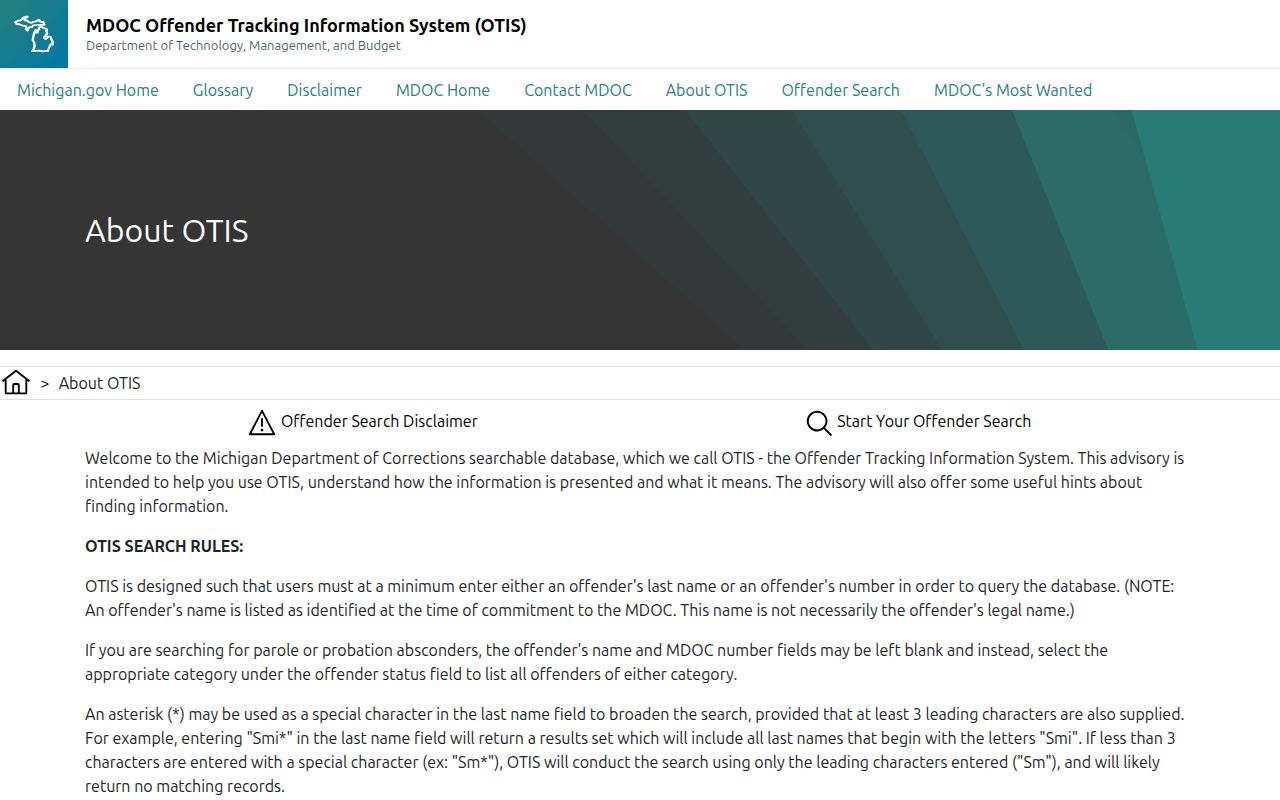
The screenshot helps identify the official terms. It should not be used to infer a date for a person whose record has not been identity-matched.
Keweenaw OTIS Display Limits
OTIS warns that public information can contain timing or data-entry limits. The public system does not expose every internal release packet. Its tips explain that qualifying offender information is ordinarily removed from public display three years after discharge. That is a web-publication period, not a general statement that MDOC destroyed the underlying record.
The OTIS tips and status screen is shown below.
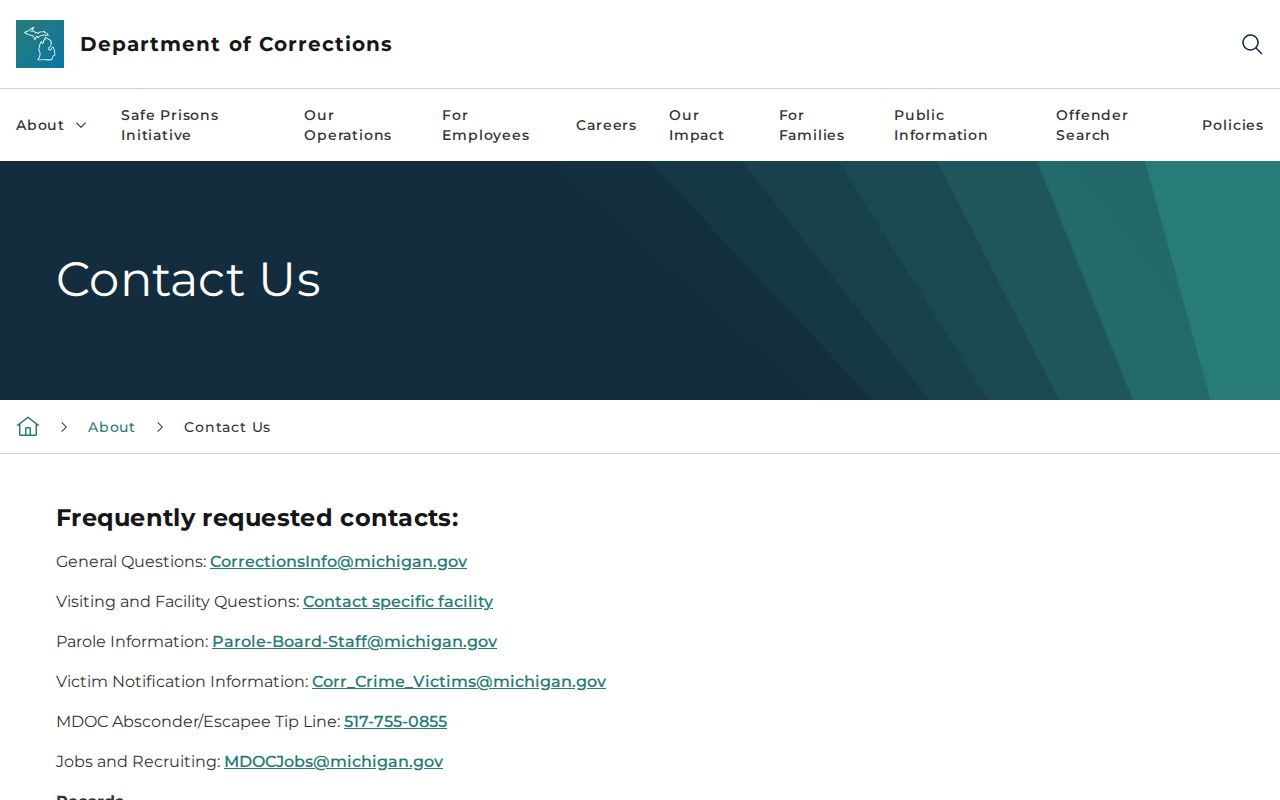
This second image supports the display limits and status cautions. For documentary proof, contact MDOC or the sentencing court rather than relying only on a saved public profile.
Keweenaw Michigan Sentence Date Rules
Michigan indeterminate sentences usually have a court-set minimum and a statutory maximum. Under MCL 791.233b for covered offenses, a prisoner generally must serve the judicial minimum in confinement before parole eligibility. Michigan should not be described with a generic “serve 85 percent” rule. That shorthand comes from a different sentencing structure and can produce a false date here.
The controlling offense date, governing statute, consecutive terms, jail credit, and court corrections all matter. MCL 800.33 addresses disciplinary credits for eligible older offense categories, with significant date and offense limits. Credits are not a universal modern way to shorten every Michigan minimum. The official OTIS computation and MDOC record should control over an estimate made from raw sentence length.
Parole eligibility also depends on MCL 791.233 and 791.234. Reaching jurisdiction does not require the Board to grant release. Life sentences and consecutive sentences can carry special rules, and some offenses are nonparolable under their governing statutes. A public summary cannot decide a life-sentence eligibility date from the offense label alone.
Note: Michigan’s operative rule for covered offenses is service of the judicial minimum, not a blanket federal-style percentage calculation.
Keweenaw Lockup Is Not Credit
The local “72-hour” phrase is operational. It describes the Keweenaw Sheriff’s short-term lockup and contract-jail arrangement. It is not a sentence-credit rule, a cap on a court sentence, or a promise that all detainees leave custody within that span. A person can move to a neighboring county jail while the same detention episode continues.
County-jail good time is a separate rule. MCL 51.282 authorizes a county sheriff to reduce an eligible county-jail sentence for good behavior under the statute’s formula and conditions. It applies to a sentenced county-jail term, not to a pretrial person waiting on bond or court action. In Keweenaw’s contract model, the agency that actually holds the sentenced person and maintains the computation must confirm the date.
A pretrial detainee has no comparable sentence calculation. Release can depend on bond, personal recognizance, dismissal, a court order, or case resolution, plus any other hold. The 97th District Court can show arraignment bond and preliminary events, while the Sheriff or receiving jail supplies the physical movement time. “Bond posted” establishes legal authority in that case, but staff must still process the person and check for other holds.
Keweenaw Release Dates Can Change
A displayed date is part of a live legal computation. Some changes alter the sentence math. Others leave the date visible but prevent release to the community. The source of the change determines which office can explain it.
| Factor | Possible effect | Source to verify |
|---|---|---|
| Sentence correction or jail credit | Moves the calculated minimum or maximum | Sentencing court and MDOC |
| Consecutive sentences | Changes how terms combine | Judgment of sentence and OTIS |
| Applicable credit regime | May affect an eligible older or county sentence | Holding agency and governing statute |
| Parole grant or denial | Determines whether release may occur before maximum discharge | Michigan Parole Board and OTIS |
| Institutional misconduct | Can affect credits or prompt grant suspension or rescission | MDOC decision and custody record |
| Detainer or another sentence | Can send the person to another authority instead of the community | Holding and receiving agencies |
| Appellate or other court order | Can revise the lawful sentence or release authority | Court file and corrected agency record |
A transfer must not be called an actual community release. This matters most at the Keweenaw lockup, where the Sheriff’s own description says longer jail service comes through contracts with neighboring counties. Ask for the receiving agency rather than hard-coding Houghton or another jail as the destination.
Keweenaw Parole Dates Need Context
MDOC’s parole process adds time between eligibility, decision, and departure. Ordinary consideration begins about six months before eligibility or reconsideration, commonly with a secure-video interview by one Board member. Most outcomes require a majority of a three-member panel. A grant moves the case into release planning and assignment to a parole agent. MDOC states that at least 28 days are required between the release decision and physical release.
A grant, hearing, and Date Paroled are therefore distinct. A grant can be suspended or rescinded after adverse information or institutional misconduct before release. A denial can set a later reconsideration point. Public-hearing notices cover narrower categories, such as certain life-sentence, commutation, and pardon matters, and are not a calendar of every routine interview.
No official consolidated public parole-results database was found. OTIS Date Paroled is the strongest public field for accomplished prison departure. For the underlying decision, contact the Michigan Parole Board at 517-373-0270 or Parole-Board-Staff@michigan.gov during its posted weekday staffing hours, or seek an existing releasable MDOC record. The regional supervision office should not be guessed from Keweenaw as the sentencing county because supervision follows the approved residence.
Confirm Keweenaw Actual Release Dates
For a local detainee, call Keweenaw Sheriff at 906-337-0528 and ask one clear question: was this a community release or a transfer? Request the movement time, disposition, receiving agency, and booking reference. If another jail received the person, confirm the later outcome there. A phone answer may be current, while a narrow public-record request supplies the durable release or transfer document.
For an MDOC prisoner, read OTIS and then confirm with MDOC when the exact date matters. Registering through the Keweenaw County VINELink check can add a release or transfer alert, but the notification is not the certified record and may lag. For a federal prisoner, use the BOP locator and federal record. Each system proves only its own custody event.
When an older local date is not online, ask for an existing record rather than asking the Sheriff to create a new calculation. A focused request can identify the booking or custody sheet, release form, transfer document, booking number, release or transfer time, disposition, and receiving agency. Michigan FOIA governs the response and any lawful redaction. The agency holding the sentence computation remains the source for the figure itself.
Finally, compare the court record. MiCOURT may show bond, dismissal, sentence, amended judgment, or another order that explains why release became lawful. It may not state the door time, and one case’s order does not eliminate another hold. The best confirmation pairs the dated custody record with the court or parole action that authorized the movement.
Note: A projected date forecasts one legal path, while an actual release requires a completed event recorded by the holding agency.