
Keweenaw 72-Hour Release Feed
No official Keweenaw County web page was found that publishes people released during a rolling 72-hour period. The Sheriff's official page, which listed Sheriff Curt Pennala at the research date, describes a fully accredited 72-hour lockup and contracted jail services for longer incarceration. It does not provide a release-list URL, public roster archive, feed cadence, retention period, or booking-photo column.
The distinction is more than a label. A release list would describe events over a time range. A lockup describes the facility's local holding function. The end of a Keweenaw stay may be a direct community release, a bond release, a court-ordered release, or a physical transfer to another county. Only an agency event record can show which occurred.
Check Keweenaw Three-Day Releases
A multi-day search works best with a written start and end date. It should include enough time to cover the suspected booking, transfer, or release without asking for an undefined archive. The Keweenaw County Sheriff's Office is the first custodian to contact. If it identifies a transfer, the search shifts to the named receiving jail for the rest of the three-day period.
- Write the full name, known name variants, and the approximate start and end dates of the Keweenaw County custody episode.
- Call the Sheriff at 906-337-0528 and ask whether local custody ended by community release or transfer during that period.
- Ask for the booking number, movement timestamp, disposition code, and receiving agency. Do not guess the contract jail.
- Check Michigan VINELink for a release or transfer event tied to the correct name and custodial agency.
- Review MiCOURT and the correct court for a bond, dismissal, sentence, or order that may explain the movement.
- Submit the Keweenaw Sheriff records form with the same date range when written proof is needed.
Use the Keweenaw County 24-hour release check when the question is limited to today. A wider period should not be reduced to a same-day phone snapshot.
Match identity before joining events across the range. Compare the full name, middle name or initial, booking number, court file number, birth year, and agency. A name match in a neighboring county may belong to someone else. If a spelling differs, ask the Keweenaw Sheriff which identifiers traveled with the transfer. When sources conflict, give more weight to a dated agency record than to an undated search result, then ask the custodian to reconcile the difference.
Note: Include the same date range in each inquiry so Sheriff, VINE, and court events can be compared on one timeline.
Keweenaw 72-Hour Release Fields
There are no public feed columns to reproduce. The useful field inventory is therefore a request list drawn from the local release-record research. These fields distinguish departure from freedom and keep the result tied to one booking. A response may be redacted or partial under Michigan law, but even a limited movement record can identify the next custodian.
| Requested field | Use across the three-day window |
|---|---|
| Name and booking number | Separates the correct custody episode from a person with a similar name. |
| Booking date and time | Places entry into Keweenaw custody on the timeline. |
| Release or transfer time | Shows when Keweenaw physical custody ended. |
| Release code or disposition | Identifies the recorded type of movement. |
| Receiving agency | Names the office that must answer the next custody question. |
| Court or case number | Connects the movement to the public legal record when available. |
Request the booking photograph separately if it is relevant and retained. An image does not establish the release time or endpoint. Likewise, a charge listed at booking is not a final disposition.
Keweenaw Weekend Release Records
A three-day frame is useful when the likely event crossed a weekend, holiday, or ordinary day boundary. Keweenaw County does not publish a fixed weekend release hour or a special holiday schedule. The safe approach is to specify the complete calendar range and ask when staff recorded the actual physical movement. A court entry and jail-door event may not share the same timestamp because staff must process the order and check for other holds.
The district and circuit courts answer different parts of the case. The district court commonly handles arraignment, bond, misdemeanors, and early felony proceedings. The 12th Circuit Court holds the durable felony disposition and sentence record after a case reaches that level. The official 12th Circuit Court page is one source for confirming the correct court before requesting an official order.
The court source shown below documents the circuit-court route, not a roster or release feed.
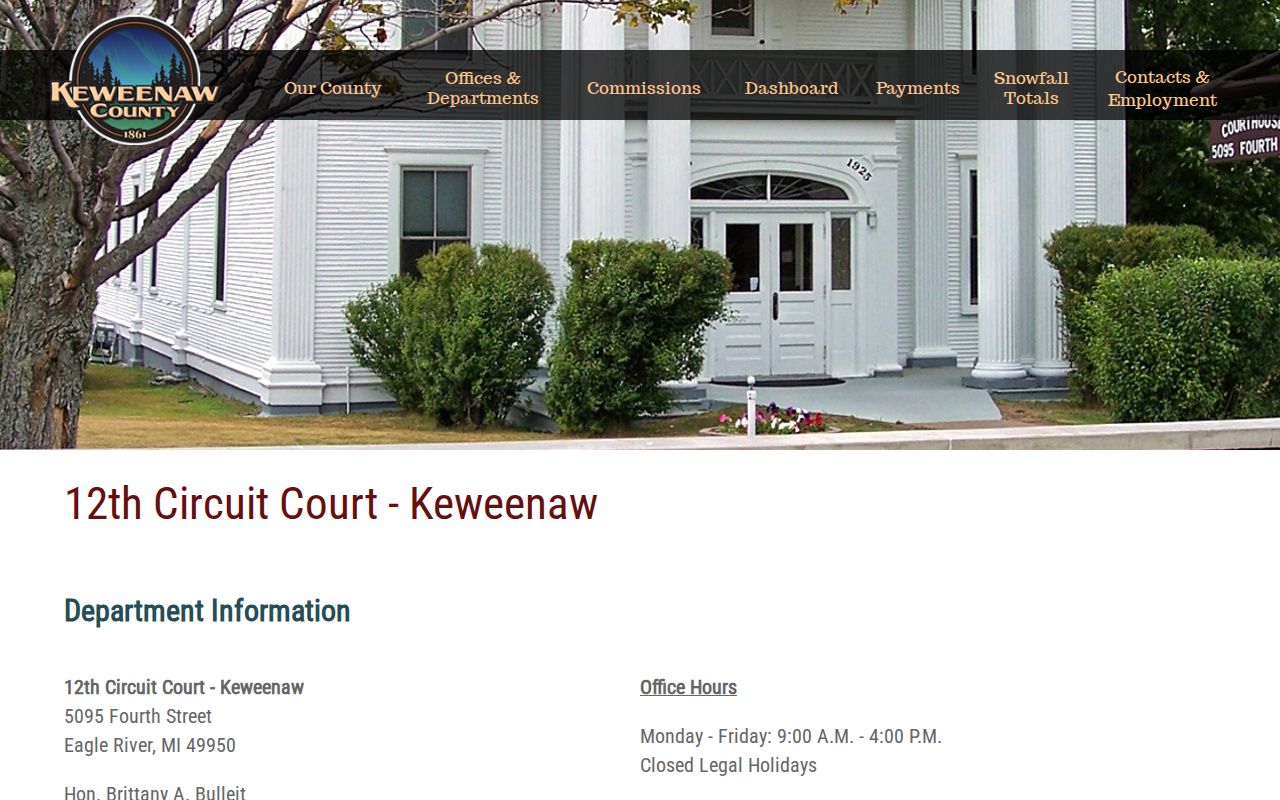
Use the court page to identify the legal record, then return to the Sheriff or receiving agency for the physical release or transfer time.
Lockup Versus Keweenaw Release List
Keweenaw County's central data quirk deserves its own check: “72-hour lockup” and “72-hour release list” are not interchangeable. Research found the former and no official evidence of the latter. If a future live roster appears, a name dropping from it would still be weak proof because a person can move from Keweenaw to a neighboring county without entering the community.
Ask a binary first question: “Was this a community release, or was custody transferred?” If transferred, obtain the actual receiving agency. The Houghton County Corrections page confirms that facility may house Keweenaw inmates when a bed is available. That conditional wording matters. Houghton is a documented possibility, not the fixed endpoint for every detention that lasts longer than the local lockup period.
- Roster absence
- A missing name. It is not a proven release event.
- Release record
- An agency field showing time, disposition, and often the movement type.
- Transfer record
- A movement entry that should name or lead to the next custodian.
- Court event
- The bond, dismissal, sentence, or order that can explain the legal basis.
Note: Houghton should be contacted only after Keweenaw identifies it, or other reliable data ties the person to that facility.
Keweenaw Release Channel Limits
Each source answers a different question. The Sheriff owns the local custody movement. VINELink relays a reported event but is not the certified record. MiCOURT can show why a judge authorized release, yet the docket may not state the door time. The Michigan Department of Corrections' OTIS search applies when state prison, parole, probation, or recent MDOC discharge is plausible. It is not a complete archive of short Keweenaw bookings.
| Source | Best answer | Main limit |
|---|---|---|
| Keweenaw Sheriff | Local release or transfer movement | No public rolling feed |
| Receiving jail | Status after transfer | Agency must first be identified |
| MI-VINE | Reported release or transfer event | Data can lag and is not certified |
| MiCOURT or clerk | Bond, disposition, and court order | Not always the physical movement time |
| OTIS | MDOC custody, parole, probation, or discharge | Does not cover every county booking |
Preserve Keweenaw Release Provenance
A focused public-record request supplies provenance when no official list exists. Ask for the existing booking jacket, release form, or transfer document for the named person and date range. Michigan FOIA does not require the county to create a new three-day report. It does provide a process to inspect or obtain existing nonexempt public records.
Under Michigan FOIA, the public body generally responds within five business days by granting, denying, granting in part, taking a permitted extension, or issuing an authorized fee or deposit notice. This is not always the production date. Keweenaw County has not published a fixed charge for this specific record, so request electronic delivery, an itemized estimate, and notice before costs pass a stated amount.
Keep the submitted request, confirmation, response, redaction explanation, and received record. Then compare the movement time with the court event and any VINE notification. This preserves a clear custody chain across the full three-day period. For a named-person search that may involve MDOC, federal, or immigration custody, use the Keweenaw County released inmate pathways to choose the correct system.
Older Keweenaw County movement records can outlast any online display. Michigan General Schedule 11 identifies jail inmate jackets as a record group that can include intake cards, release forms, transfer documents, mug shots, bonds, warrants, sentencing papers, and court records. Item 11.210 sets a general minimum of release plus ten years, though an approved agency-specific schedule may supersede it. Other components, such as certain property-release records and receipts, can have shorter periods. Ask which schedule governs the specific item. Retention never guarantees public disclosure because exemptions, redactions, sealed cases, and set-aside rules still apply.