
Keweenaw Parole and Probation Differences
Parole follows a Michigan prison term. The Michigan Parole Board may release an eligible prisoner before the maximum discharge date, but the person remains under Michigan Department of Corrections jurisdiction in the community. Probation is a court sentence served in the community. It may begin without prison or follow a jail term. A person released from the Keweenaw County Sheriff’s Office 72-Hour Lockup on bond is not automatically on either form of supervision. Bond conditions come from the pending court case, while parole and probation arise from a sentence or parole decision.
The legal status controls which record to use. OTIS, the MDOC Offender Tracking Information System, can show parolees, many circuit-court probationers, active prisoners, absconders, and qualifying discharged people. The court register of actions supplies the probation order, amended order, and later discharge order. Keweenaw Sheriff records instead show whether the person left the lockup or went to another jail. These records should not be merged into one broad meaning of “released.”
| Feature | Parole | Probation |
|---|---|---|
| Starting point | Release from an MDOC prison after Board action | A community sentence ordered by a court |
| Public check | OTIS Current Status and Date Paroled | OTIS Current Status plus the sentencing court file |
| Authority | Michigan Parole Board and MDOC | Sentencing court and MDOC when it supervises the case |
| End point | Parole discharge or maximum discharge | Probation discharge order or lawful completion |
- Parole
- Release from prison while MDOC jurisdiction continues.
- Probation
- A sentence supervised in the community under a court order.
- Discharge
- The end of the listed supervision term or MDOC jurisdiction.
- Absconder
- A person reported as unavailable to or noncompliant with supervision, not a person who completed supervision.
Verify Keweenaw Post-Release Supervision
Start with the official MDOC OTIS search when a Michigan prison, parole, or MDOC-supervised probation case is plausible. An MDOC number is the most exact key. Otherwise, use the last name and first name, then narrow by age, status, or other available fields. Open the profile and compare the county, court file number, sentence, and identifiers. A shared name is not enough. Read Current Status rather than relying on an old sentence block or photo.
Verification should connect the status to its source. OTIS may identify parole, probation, discharged status, a supervising location, or an absconder code. The correct court record can confirm the probation sentence and discharge. For a local jail-only case, OTIS may return nothing because Keweenaw’s short lockup is not an MDOC population database. The broader Keweenaw County released-inmate search path explains how Sheriff, court, and custody records fit when no state supervision exists.
- Search OTIS by MDOC number when known, or by a carefully matched name.
- Compare the county, case number, status, age information, and sentence before accepting the match.
- Read Current Status and note any displayed supervising office, agent information, Date Paroled, or discharge entry.
- Check the sentencing court register for the probation order, later amendments, and discharge order.
- Confirm the current office through the MDOC field-office directory because residence or a case transfer can change supervision.
OTIS uses concise codes. PAROLE means the Parole Board released the person from prison and MDOC jurisdiction continues. PROB means circuit-court probation supervised by MDOC. ABSCOND1 identifies a parole absconder sought by MDOC, while ABSCOND2 identifies a probation absconder whose sentencing county has apprehension jurisdiction. DISCHRG means MDOC jurisdiction ended, but OTIS warns that discharge may reflect successful completion, maximum expiration, or death. It should not be rewritten as proof of a live community return without checking the history.
Keweenaw Supervision Follows Residence
A former Keweenaw defendant may not report to an office in Keweenaw County. Supervision follows the approved residence, and MDOC can transfer a case between offices. The official MDOC field-office directory and OTIS Current Status should therefore be read together. Publishing a guessed “Keweenaw parole office” can send a family member to the wrong place or misstate who holds the file.
The combined Houghton, Baraga, and Keweenaw Counties Parole/Probation office is the documented regional contact. Call before a visit or before assuming it supervises a named person. Neither the research nor the directory supports invented walk-in or reporting instructions. A displayed office can change after a residential move, interstate arrangement, or formal case transfer.
Houghton/Baraga/Keweenaw Counties Parole/Probation401 E. Houghton
Houghton, MI 49931
906-482-6615
Call first for current office confirmation.
This residence-based rule is Keweenaw County’s distinctive supervision issue. The sentencing county identifies the case’s origin. It does not always identify the current reporting site.
Keweenaw Parole Decision Milestones
An OTIS Earliest Release Date is not a promise of parole. MDOC’s official process says ordinary parole consideration begins about six months before eligibility or reconsideration, often with a secure-video interview by one Board member. Most decisions require a majority of a three-member panel. Special rules apply to life sentences. Reaching the Parole Board Jurisdiction Date only opens the decision process, and the Board must still apply Michigan law and its public-safety judgment.
Possible outcomes include a grant, denial, reconsideration after a stated interval, or suspension or rescission of a grant after adverse information or institutional misconduct. A favorable decision starts release planning, including assignment to a parole agent. The MDOC parole consideration process states that at least 28 days must pass between the Board’s release decision and physical release. Thus a hearing date, grant date, and Date Paroled are separate milestones. The official process screen below illustrates those stages.
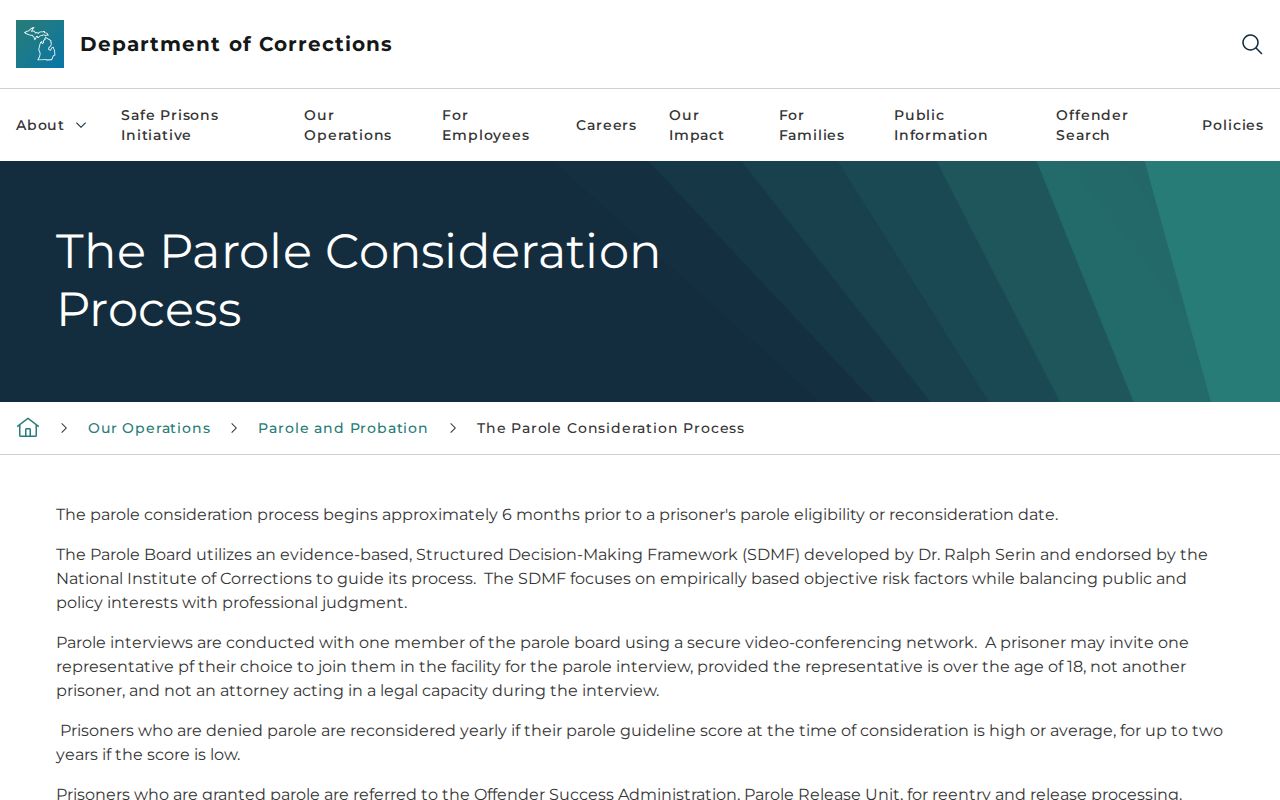
The image supports process research, but a general process page cannot prove the outcome for one Keweenaw County person. OTIS Date Paroled or the originating custody record confirms actual prison departure.
Note: A parole grant remains prospective until MDOC completes release planning and the custody record shows the person actually left prison.
Keweenaw Parole Hearing Limits
Michigan’s public-hearing page is narrower than a general parole calendar. It concerns public proceedings in categories such as Lifer Law, commutation, and pardon matters. It does not list every routine parole interview or every returned-parole-violator matter. MDOC says individual notices are commonly released from about two weeks to 30 days before a public hearing, and public attendees must register at least two business days in advance.
The MDOC public-hearing registration page shows the limited notice route.
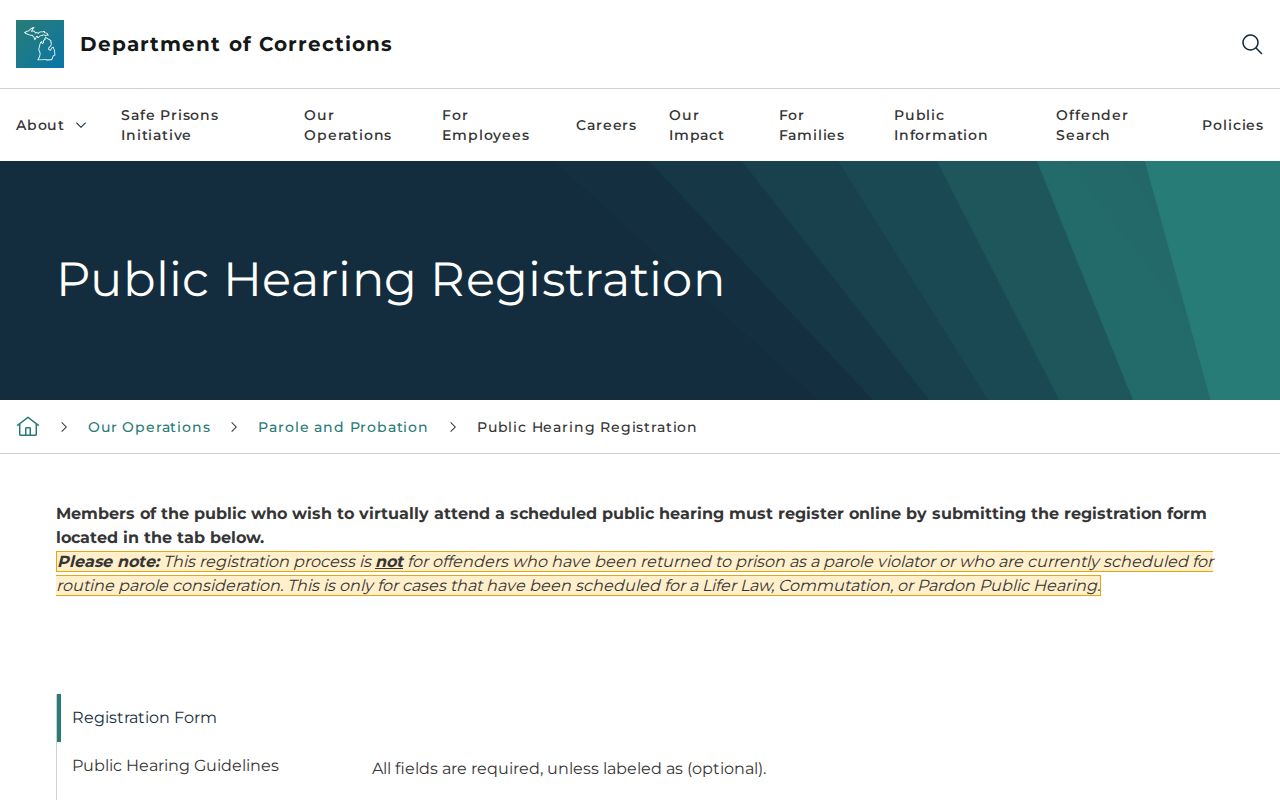
The MDOC page helps locate a current notice, but no official consolidated county-by-county decisions database was found. An expired announcement must not be treated as a recurring schedule or proof that a particular hearing remains pending.
For a decision not resolved through OTIS, the Michigan Parole Board can be reached at 517-373-0270 or Parole-Board-Staff@michigan.gov during the posted Monday through Friday, 8 a.m. to 5 p.m. staffing window. A lawful MDOC records request may also seek an existing releasable record. Direct victims can use the MDOC Crime Victim Notification Unit at 877-886-5401 for applicable rights and notices.
Keweenaw Absconder and Violation Status
An absconder status is not a discharge. It signals an alleged failure to stay available or comply with supervision and may be linked to a warrant. A parole violation, new detainer, or return to custody can also alter the public status. OTIS should be checked for the latest entry, but a web label alone should not be used to declare that a warrant is active. Confirm warrants with law enforcement or the supervising office.
MI-VINE offers custody-event notices for participating Michigan agencies, including release, transfer, or escape events. It does not replace an MDOC supervision record. The service can help track a return to physical custody, while the supervising office and court explain the legal basis. The Michigan State Police Sex Offender Registry is also separate. It includes only people required by law to register and is not a parole, probation, or general release list.
Keweenaw Supervision Discharge Records
Supervision ends through a lawful discharge, not through a missing roster entry. For probation, the sentencing court may keep the discharge order in the case file. For parole, OTIS can show a changed Current Status while the profile remains within its public display period, and MDOC holds the originating record. OTIS explains that qualifying public information may be removed after three years from discharge. Removal from the public web is not proof that the agency destroyed the record. A dated discharge order or agency record is the stronger source.
Michigan set-aside law can also change public visibility after probation, parole, or imprisonment milestones. A set-aside order can make the affected record nonpublic under the governing statute. Old screenshots should not be used to bypass that change. When documentary proof is needed, ask the court clerk for the public discharge order or MDOC for an identified releasable supervision record. State the name, case number, date range, and exact field sought. A precise request is more useful than asking an agency to create a broad status summary.
Note: Court discharge, MDOC discharge, and physical jail release can occur on different dates and must be verified through their own records.